
See Your Child’s Potential Earlier. Shape Their Future With Confidence.
Early Talent Intelligence
Every Child CarriesExtraordinary Potential.BTA Helps You Understand It.
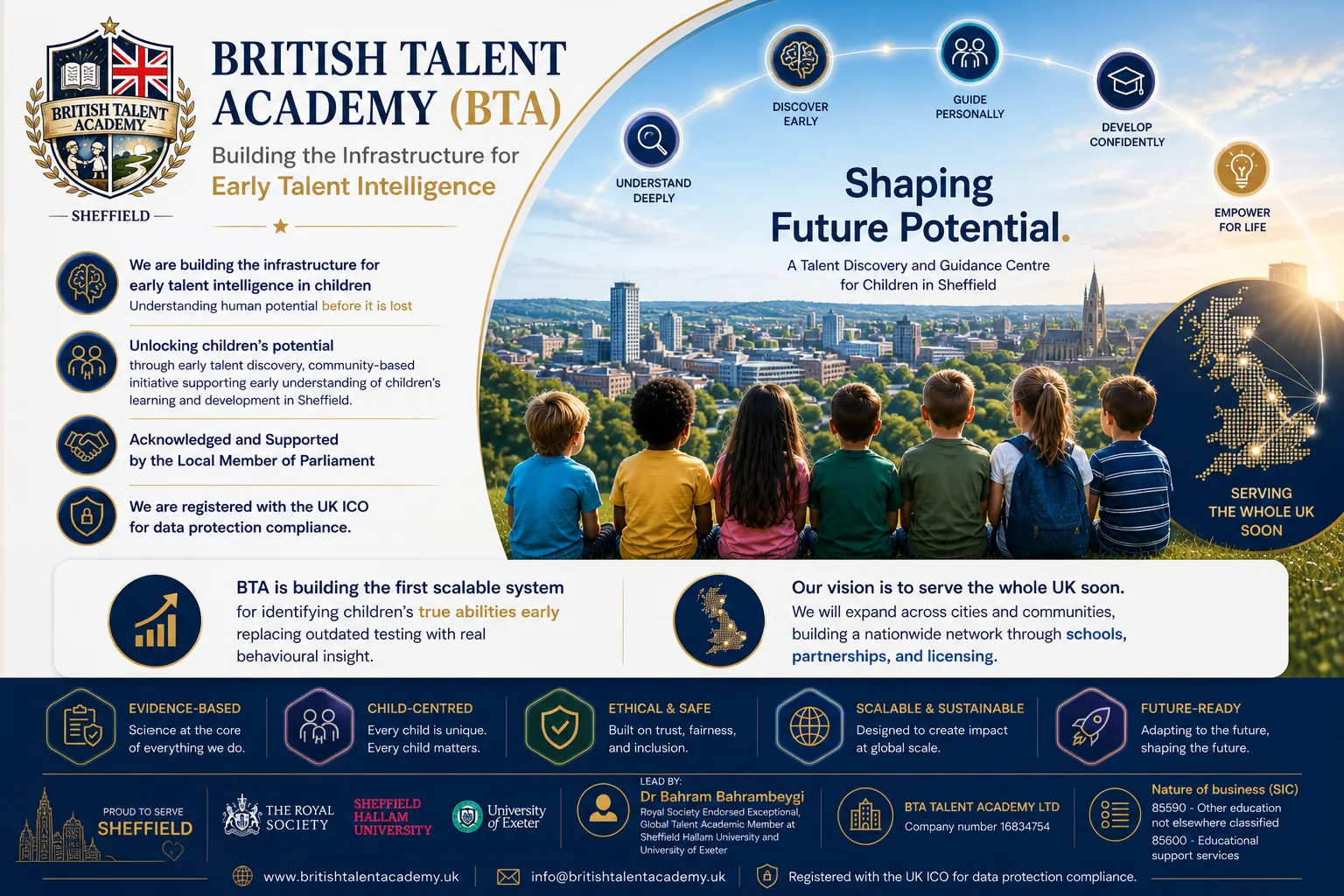
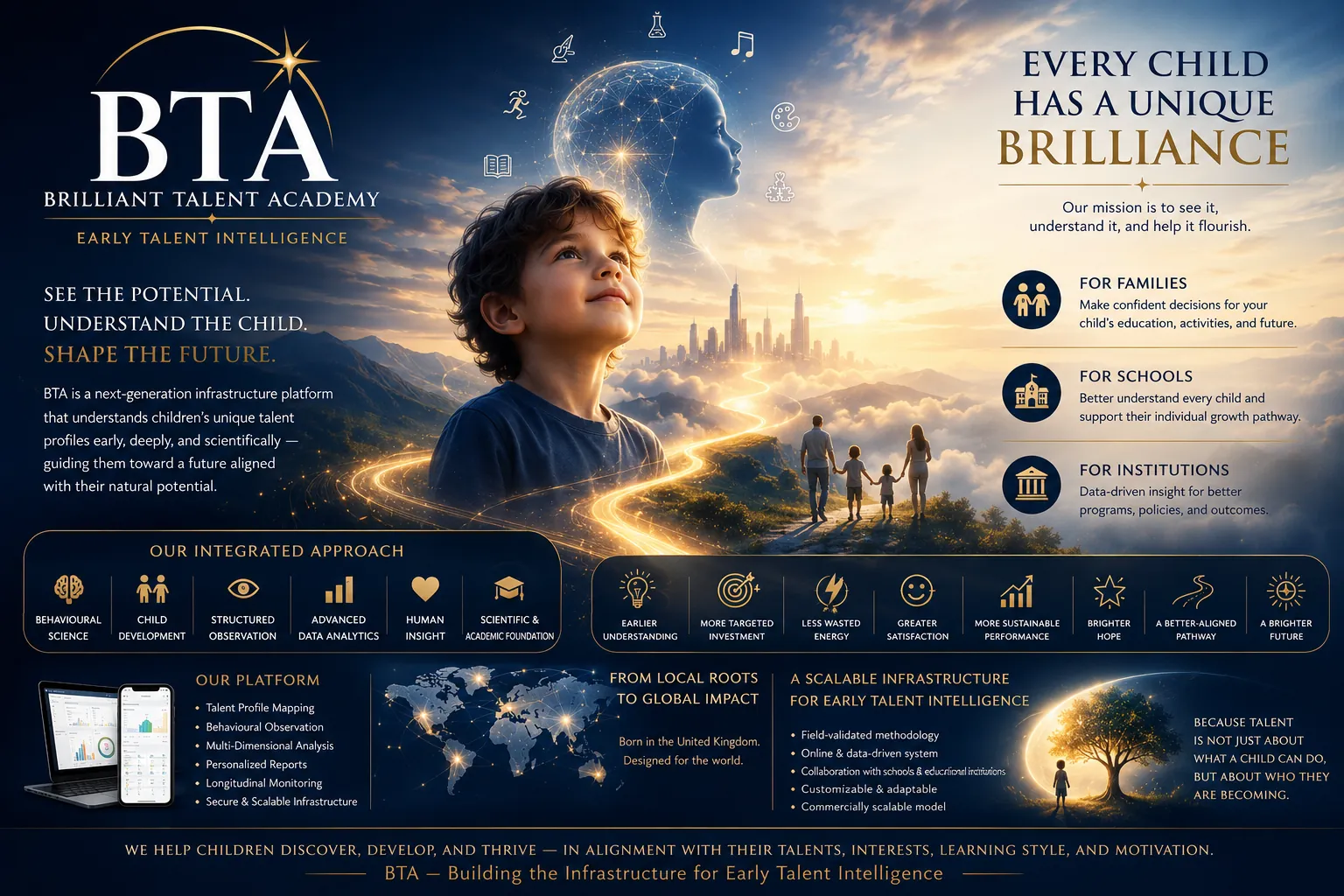
A premium Early Talent Intelligence platform helping parents and schools understand how children think, learn, engage, and grow through guided observation, behavioural insight, and specialist review.
Designed for selected families and schools during the founding pilot. Not tutoring. Not a test centre. A deeper way to understand development.

EXPLORE BTA
Move from the homepage overview into the deeper story of Early Talent Intelligence.
 01
01
 02
02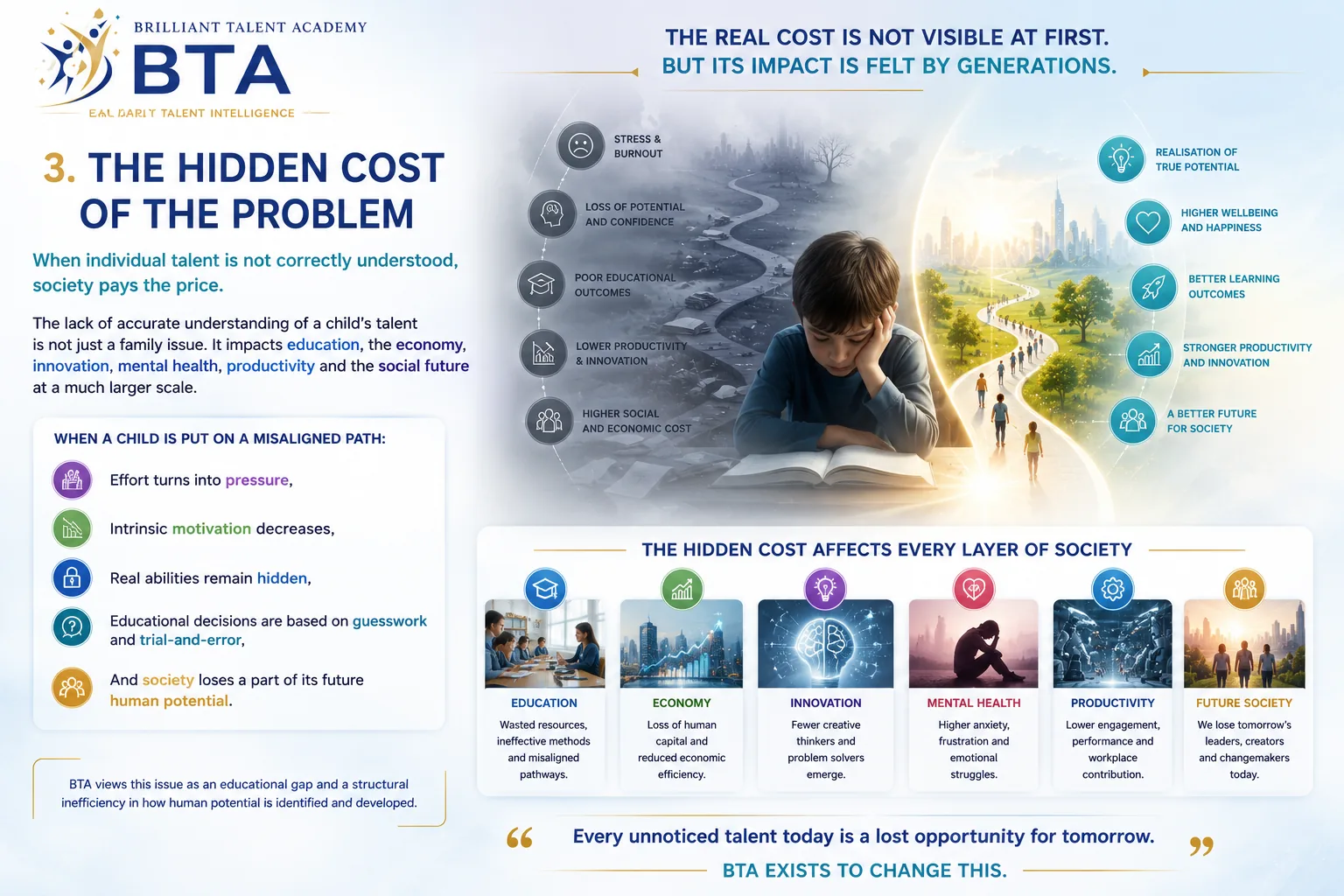 03
03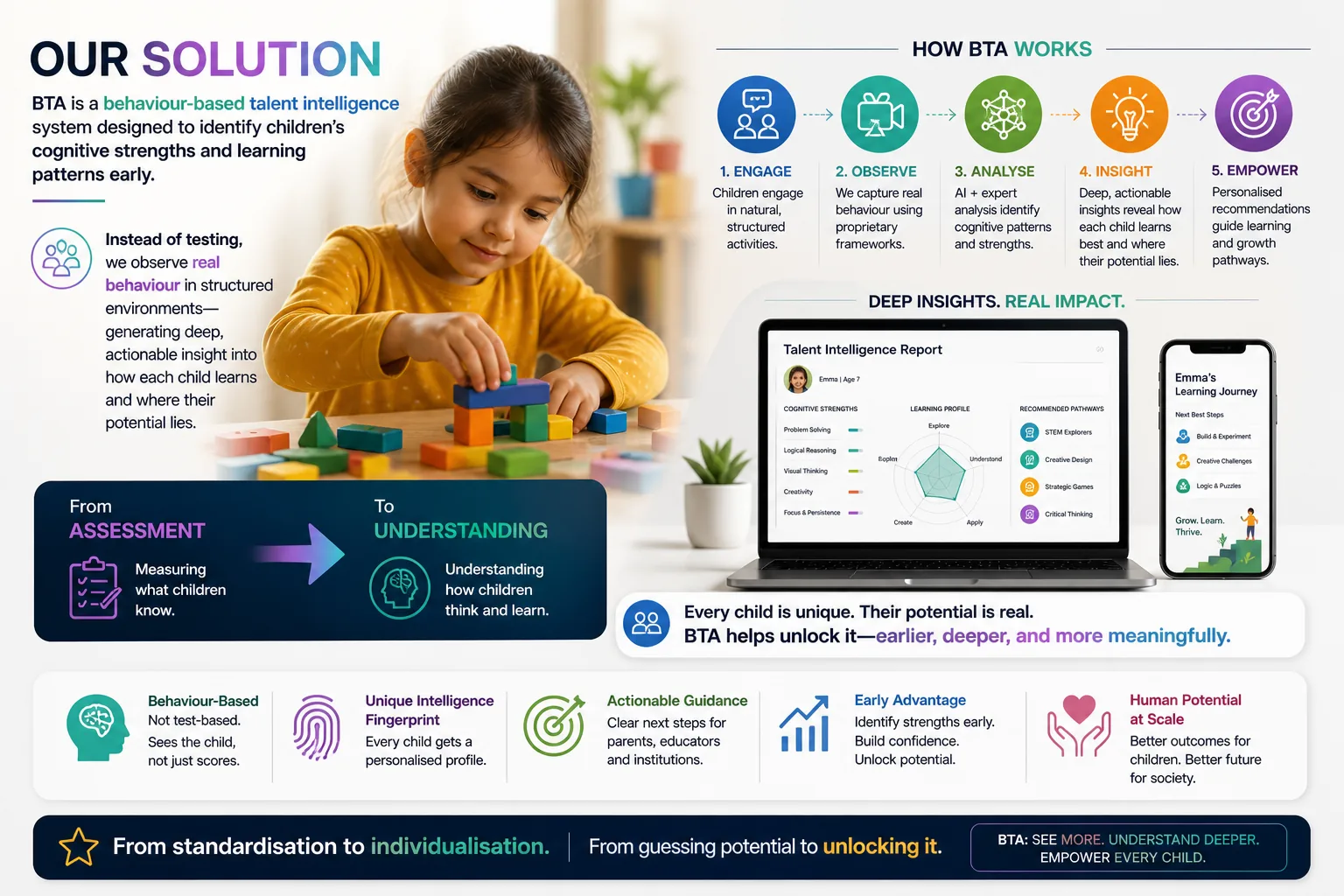 04
04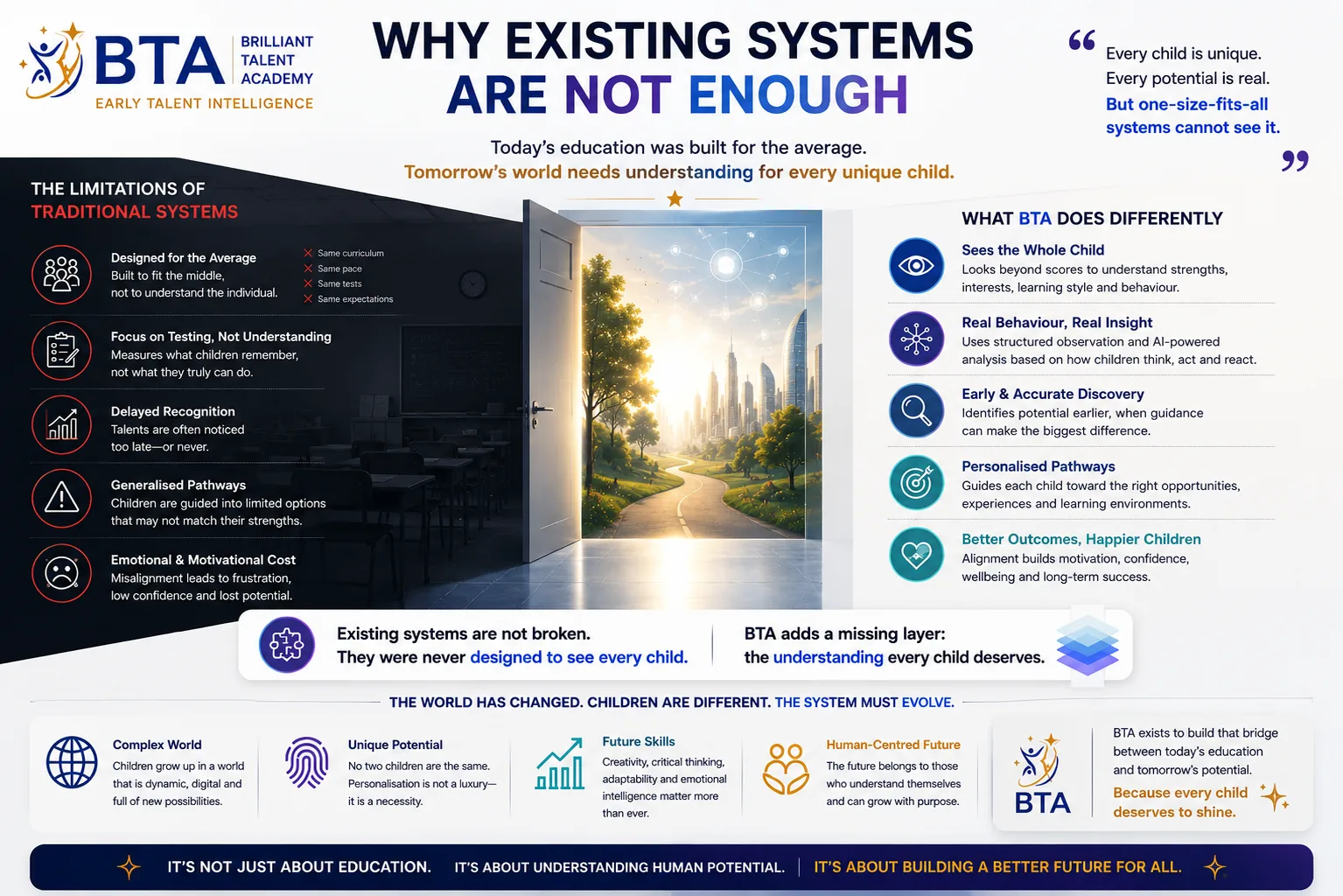 05
05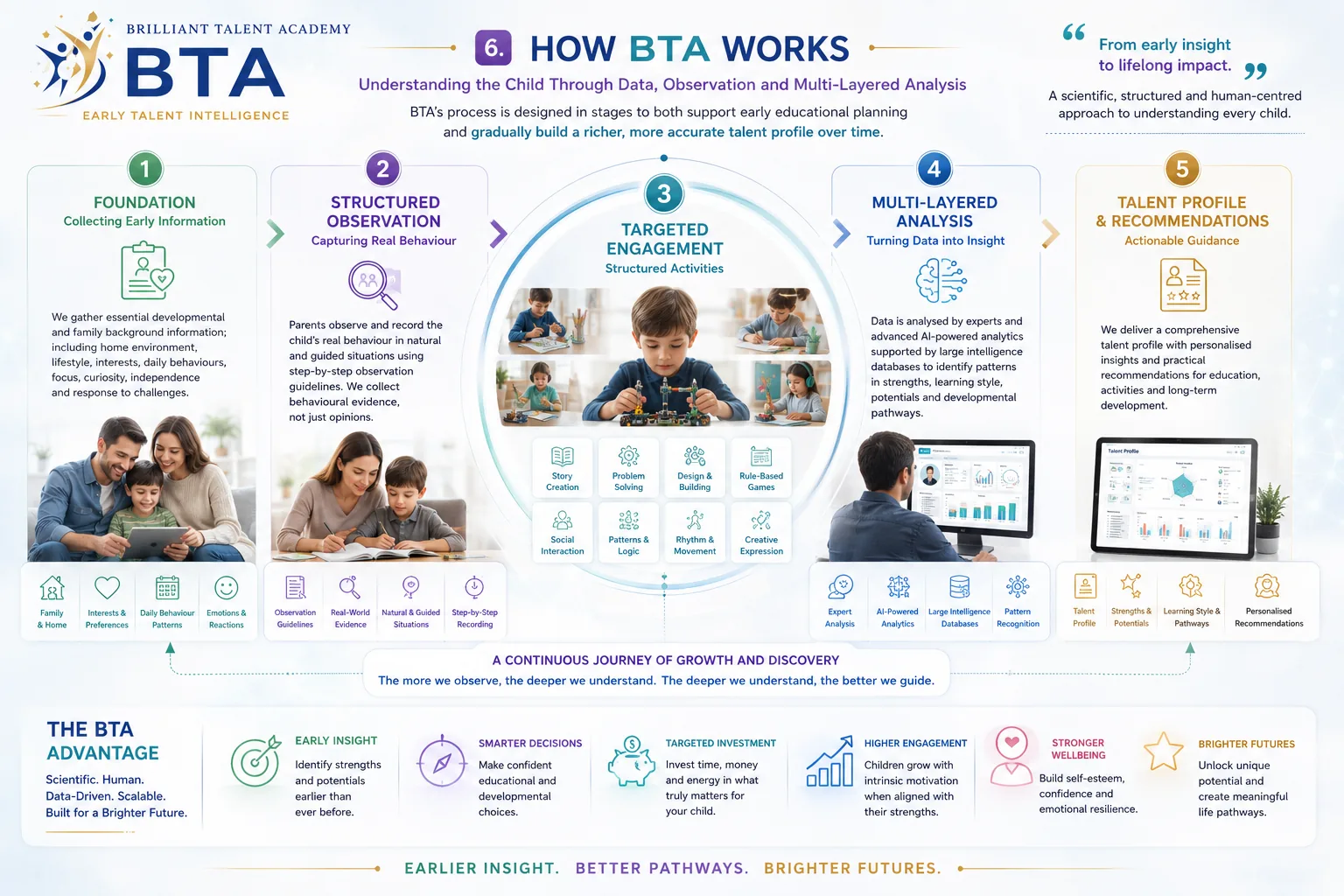 06
06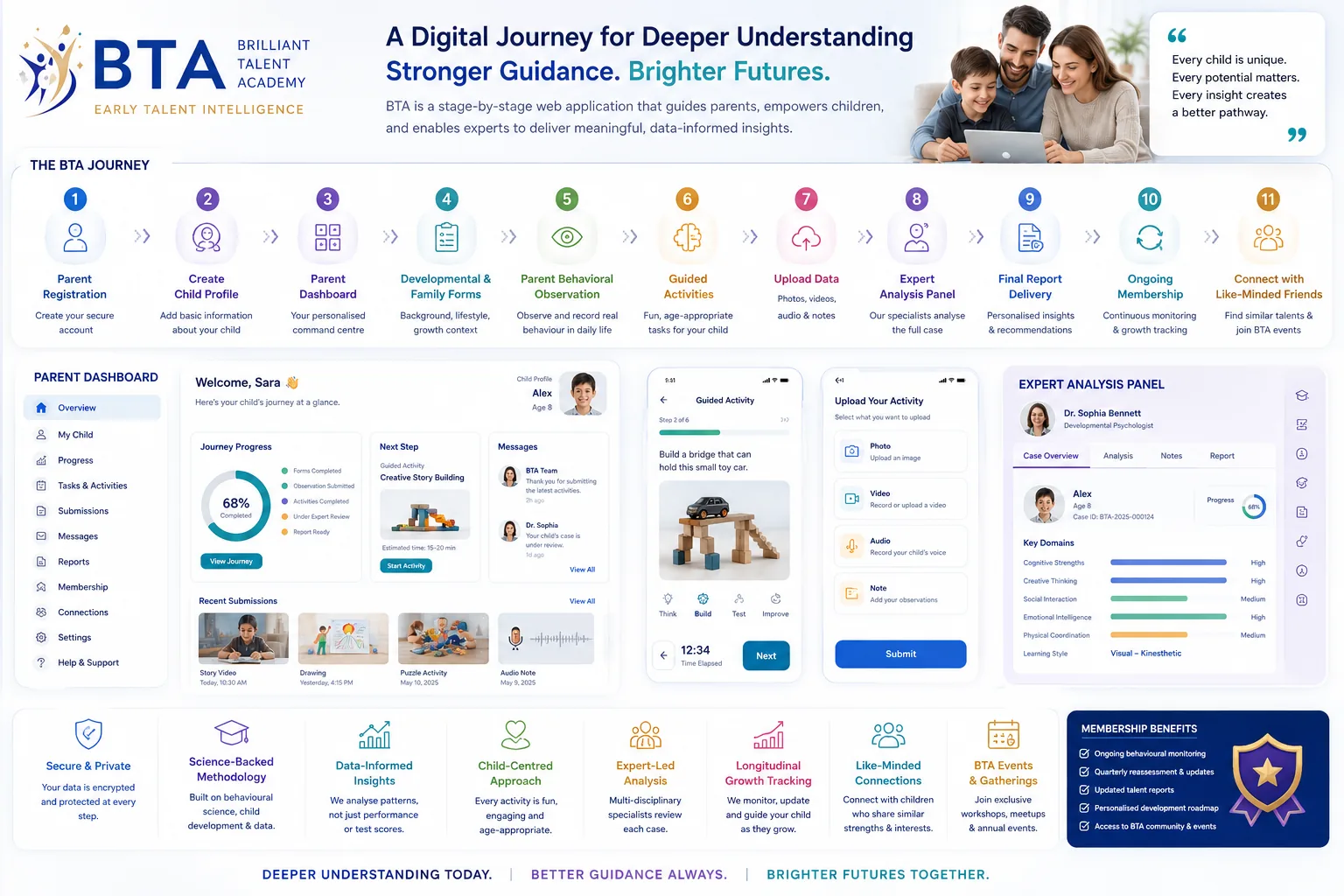
 07
07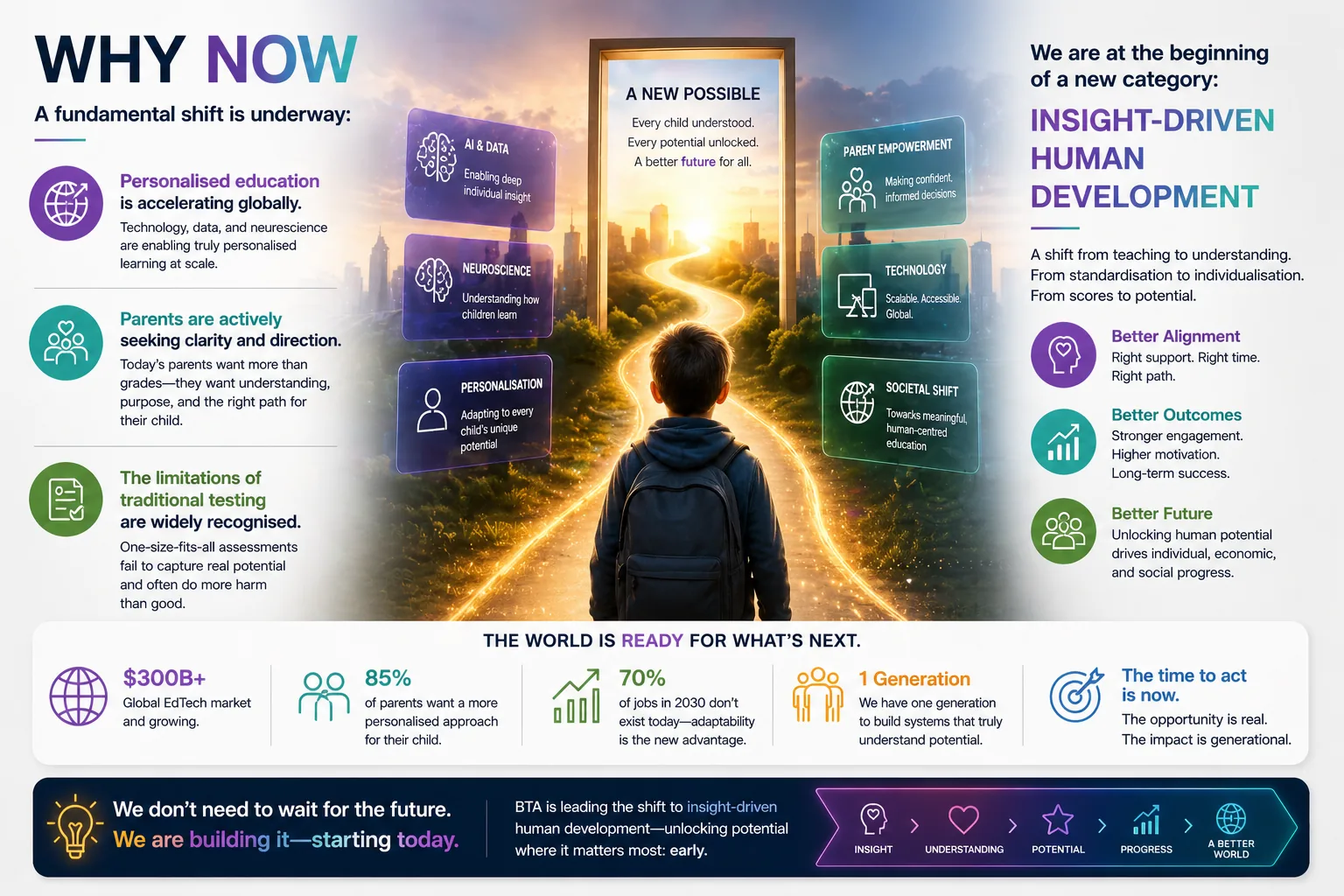 08
08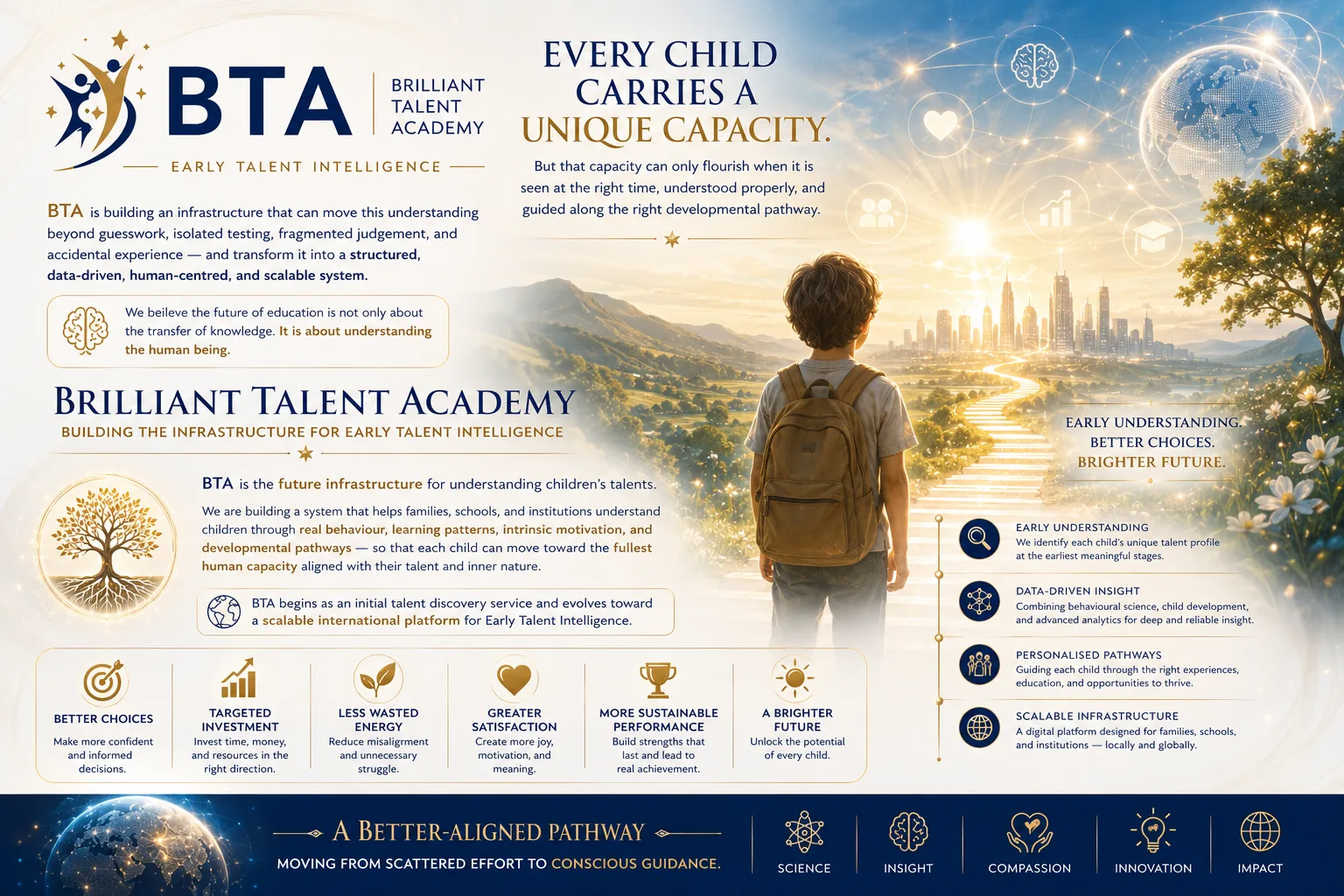 09
09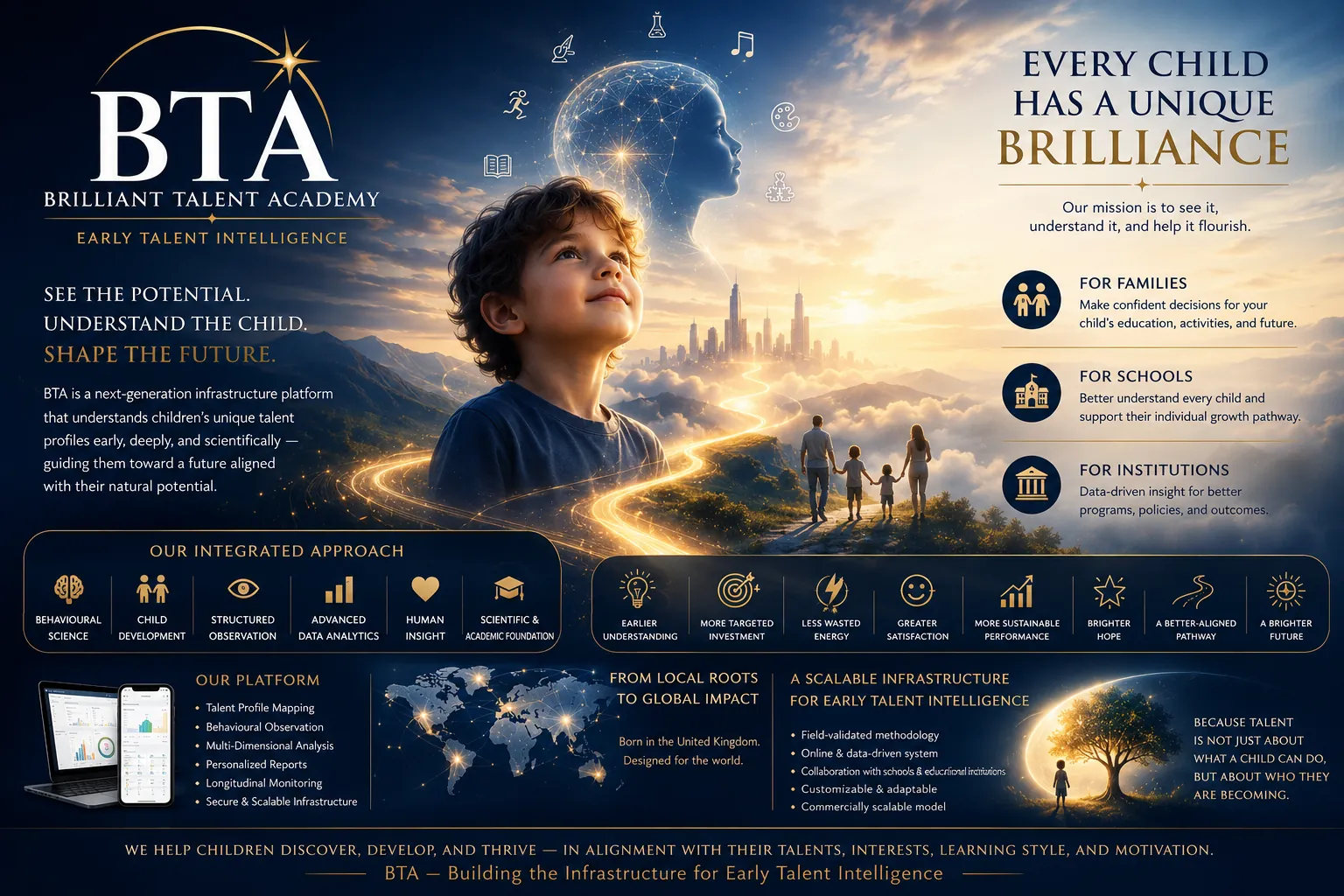 10
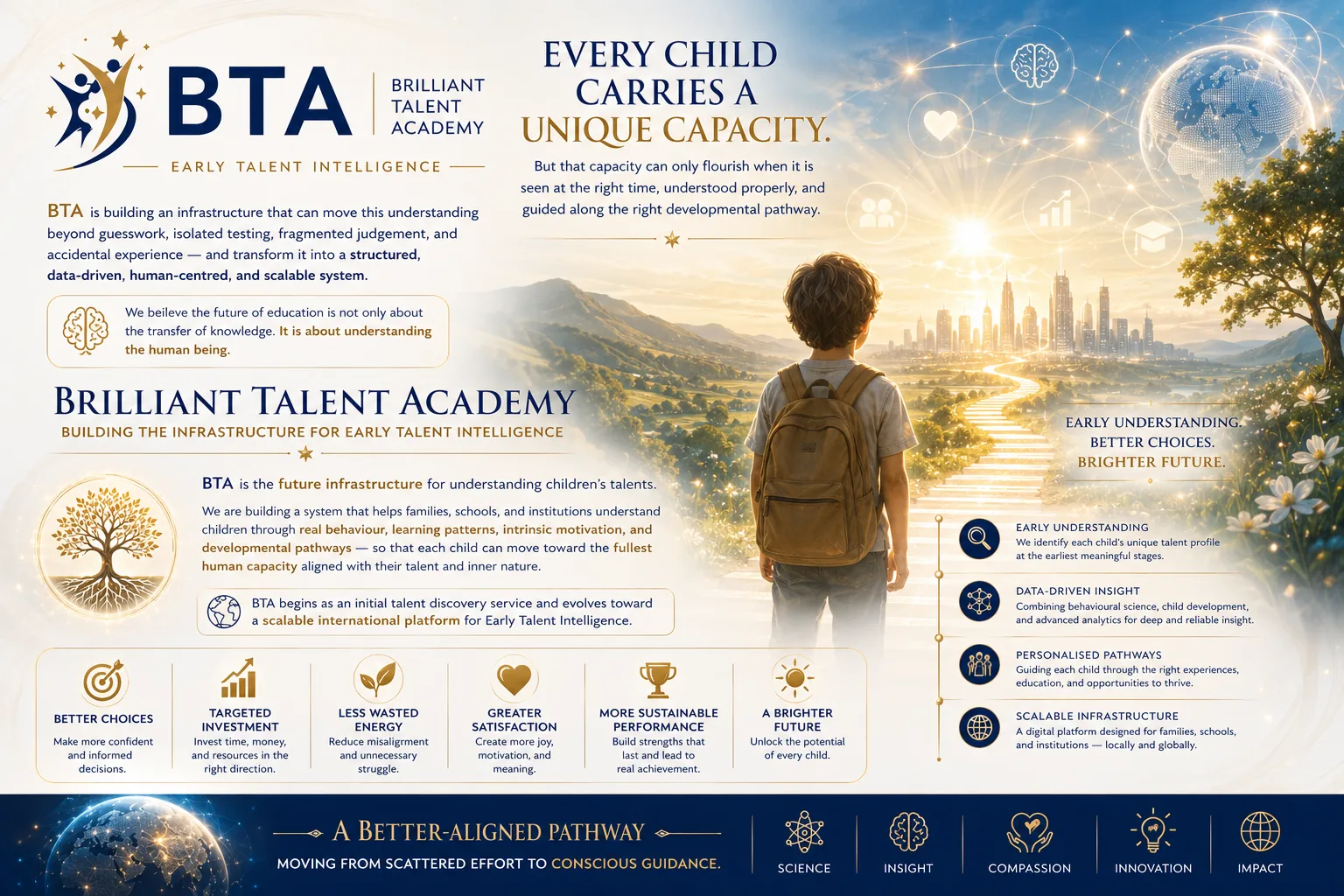
1001 · What Is BTA?
A scalable infrastructure for understanding children’s talent profiles earlier and more deeply.
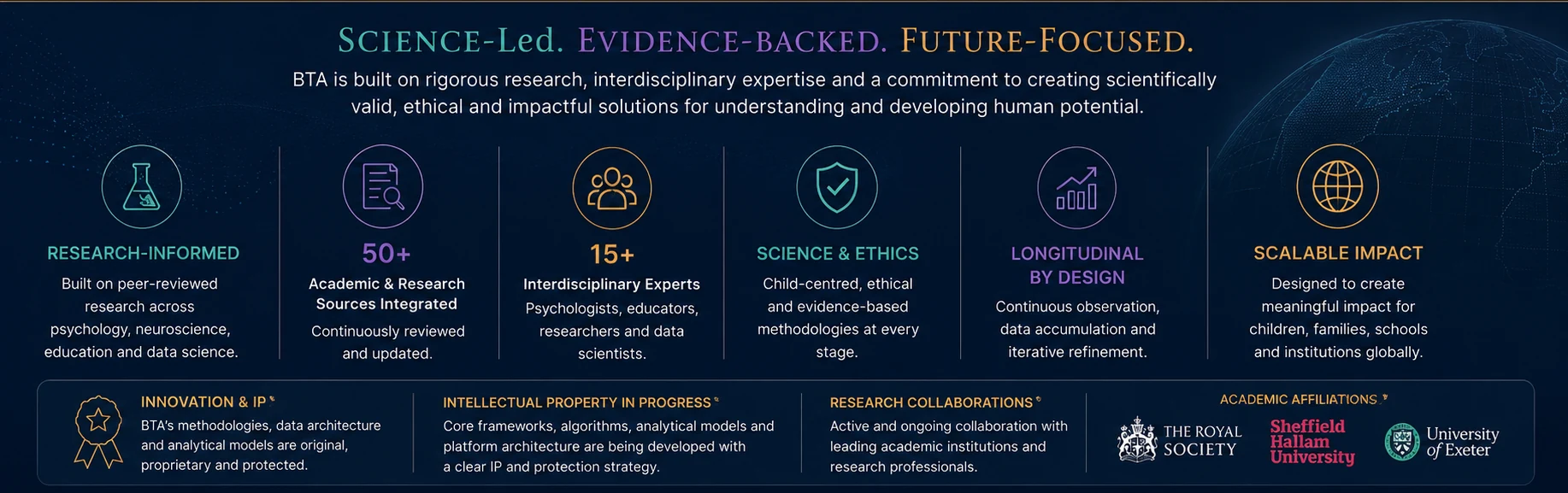
BTA combines behavioural science, child development, structured observation, data and specialist interpretation to help families, schools and institutions understand how each child thinks, learns, engages and grows.
It is not tutoring, not a test centre and not a generic school service. It is a complementary intelligence layer designed to reveal individual patterns, intrinsic motivation, learning style and developmental pathways.
02 · The Core Problem
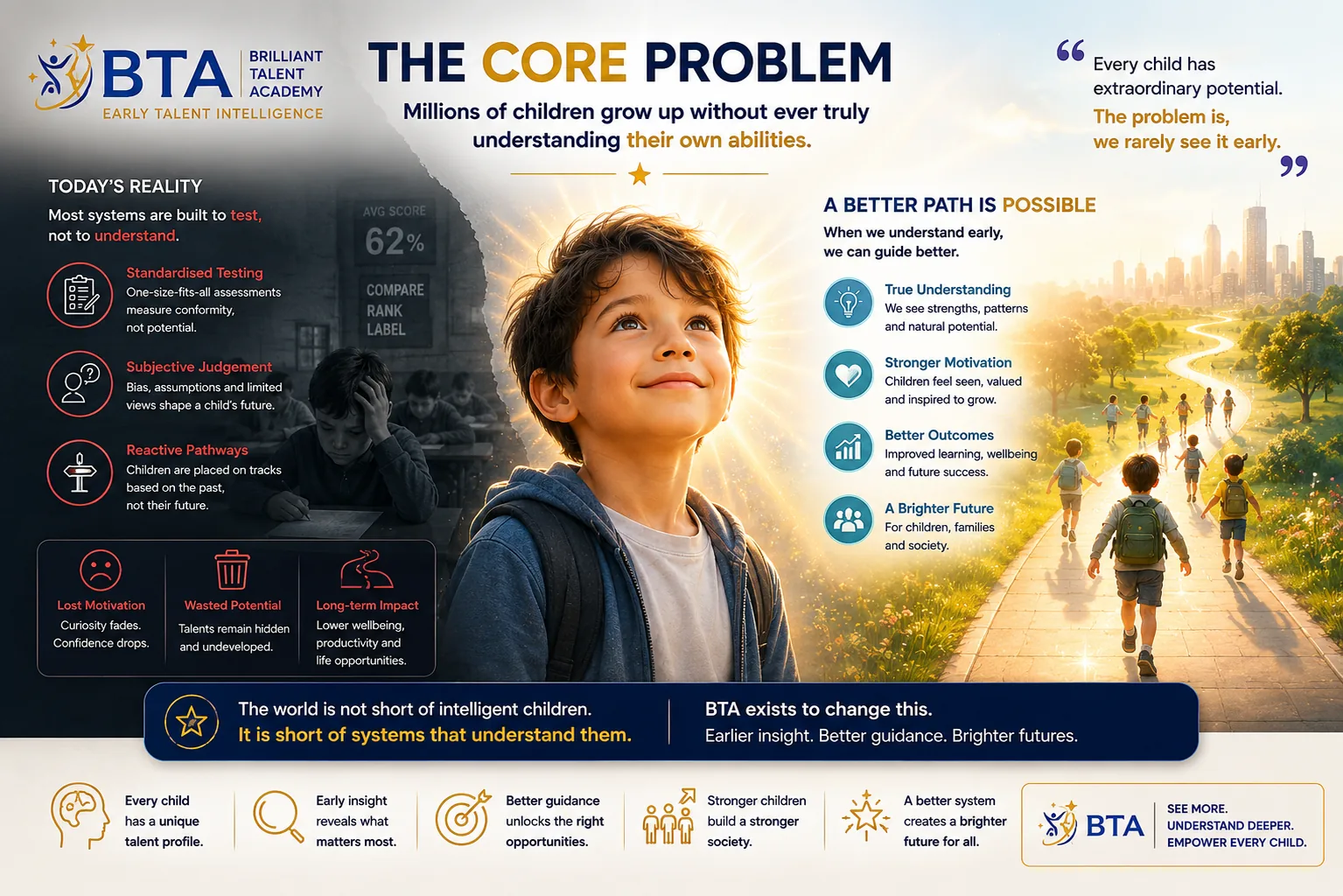
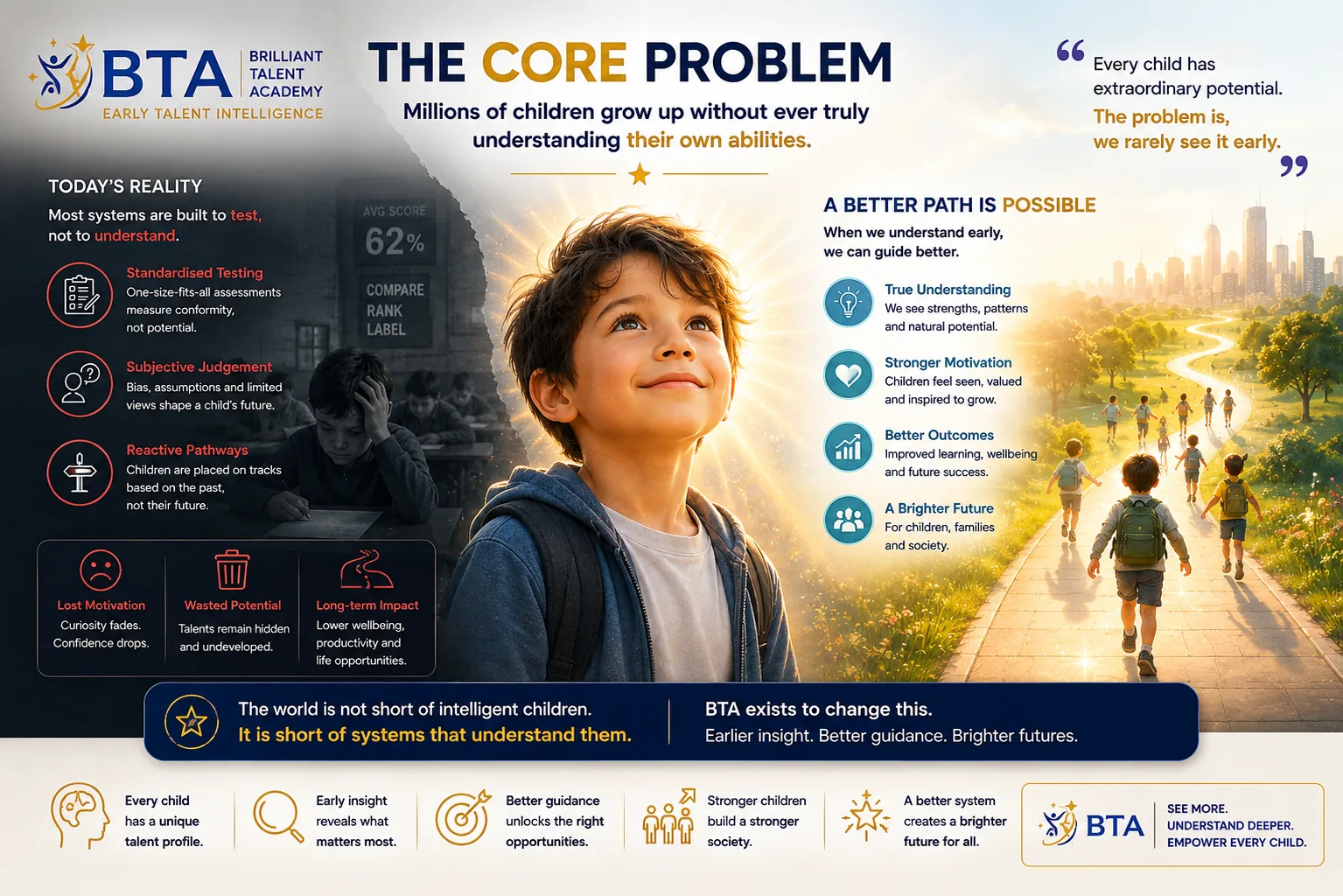
Millions of children grow without truly understanding their own abilities.
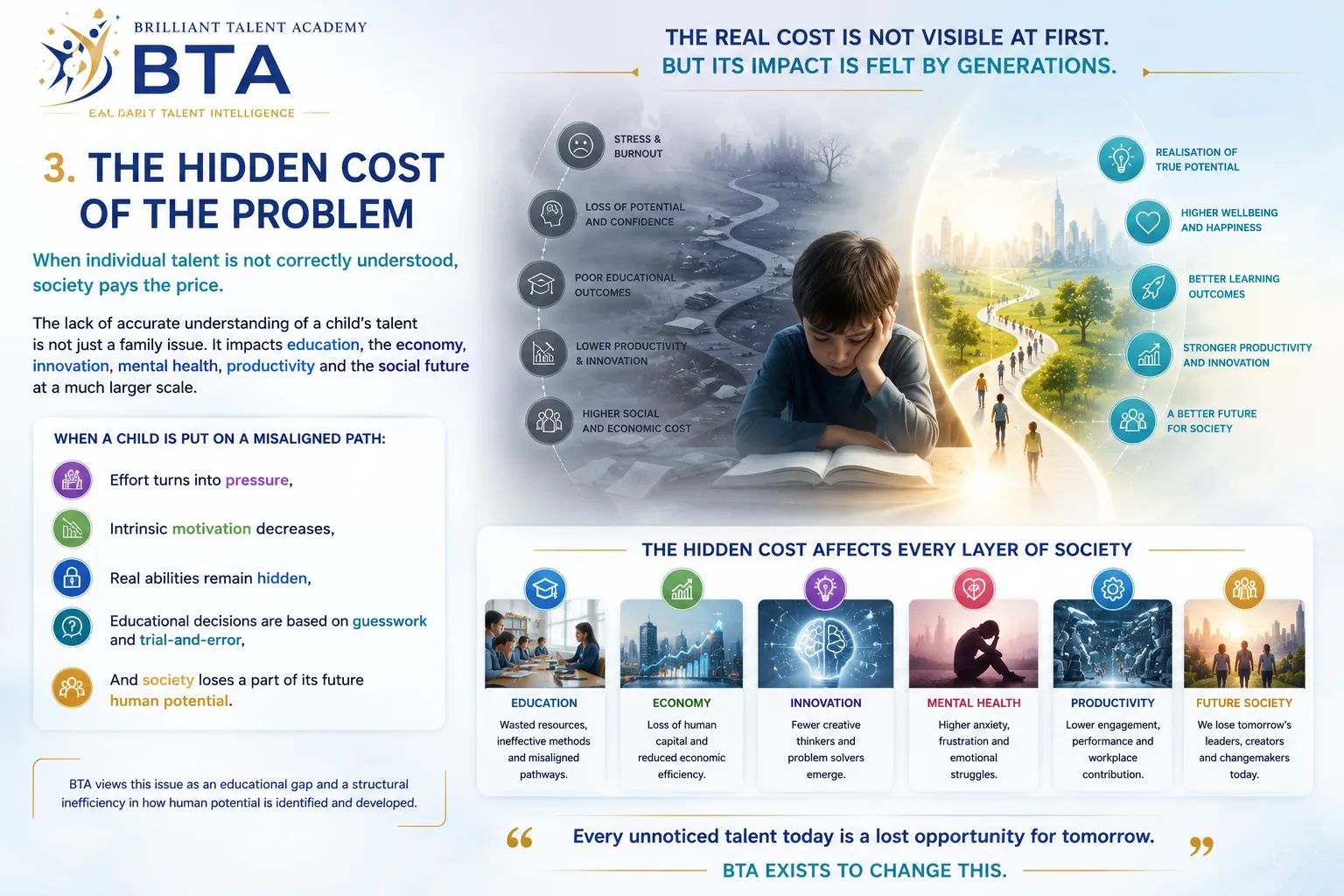
Current systems often rely on standardised testing, subjective judgement and reactive pathways. This means many children are guided by averages rather than by their real strengths, interests, behaviours and potential.
BTA exists because the world is not short of intelligent children. It is short of systems designed to understand them early, accurately and meaningfully.
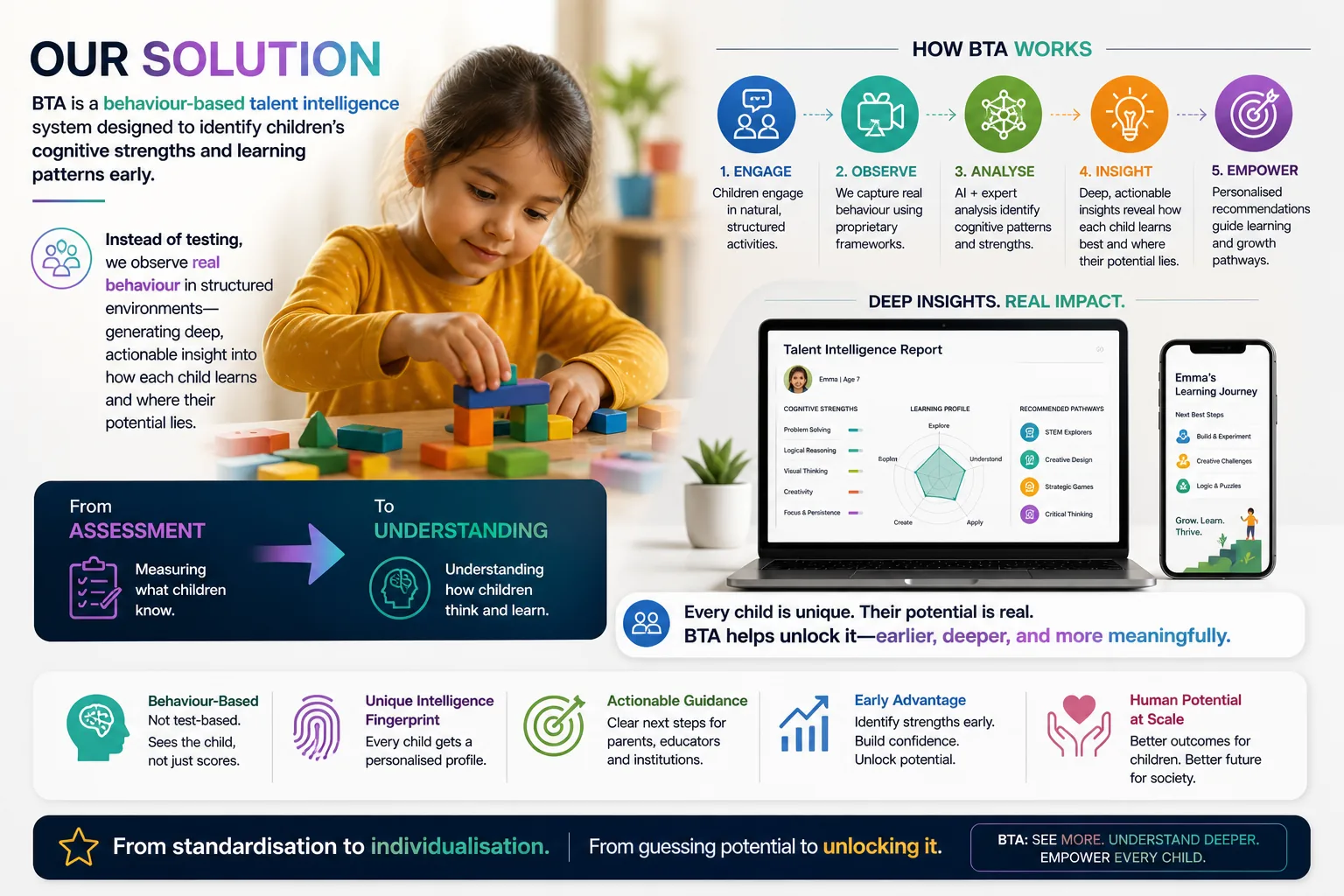
04 · The BTA Solution
From assessment to understanding. From standardisation to individualisation.
BTA observes children within structured, natural and purposeful activities that reveal how they begin, think, solve problems, face difficulty, interact and respond to challenge.
The outcome is an early, analytical and human-centred Talent Profile that helps guide choices more consciously and effectively.
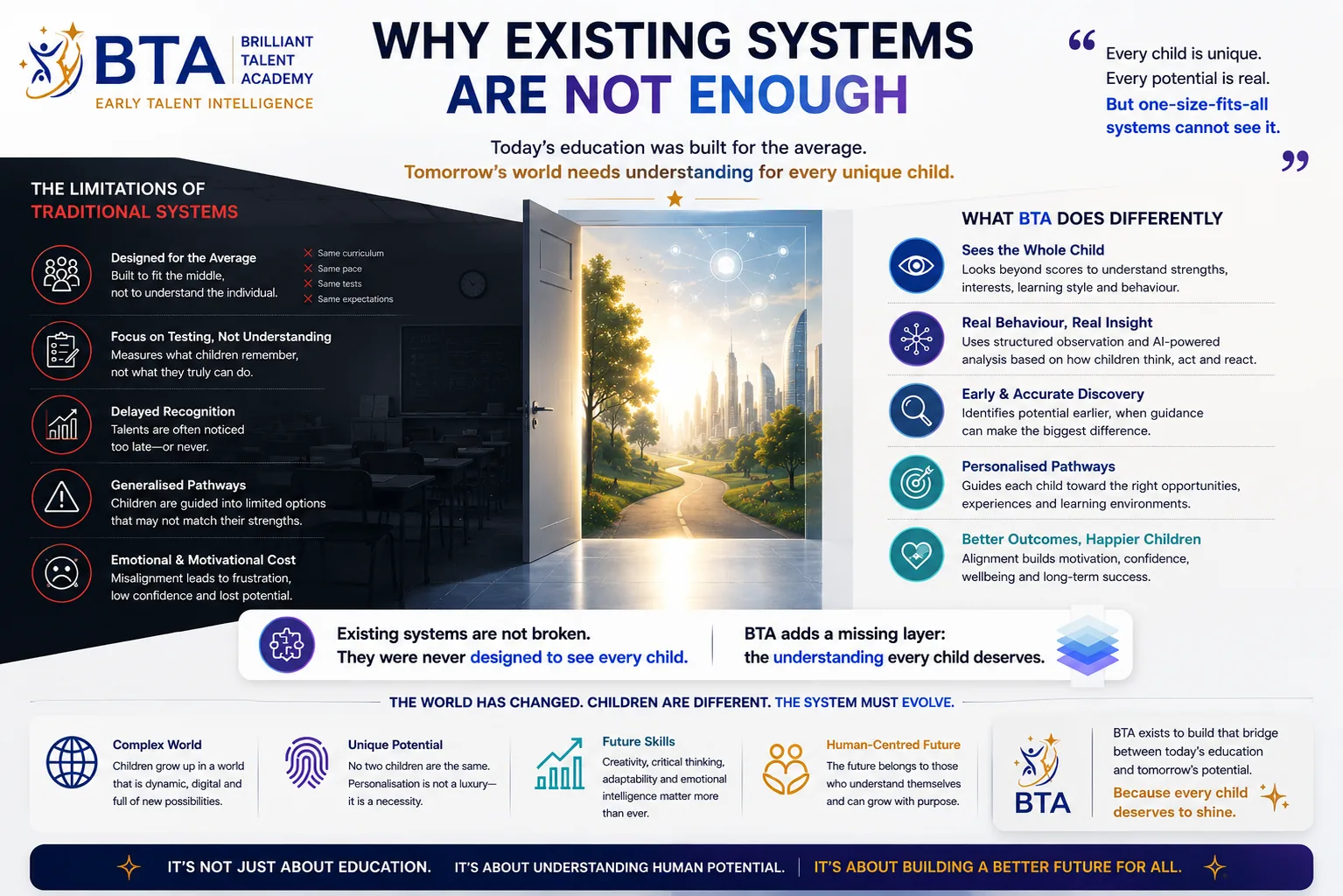
05 · Why Existing Systems Are Not Enough
Existing systems measure performance. BTA aims to understand potential.
Traditional systems often ask how well a child fits a common pathway. BTA asks what kind of pathway fits the child.
Instead of isolated results, BTA builds a deeper and evolving layer around behaviour, learning style, motivation and developmental potential.
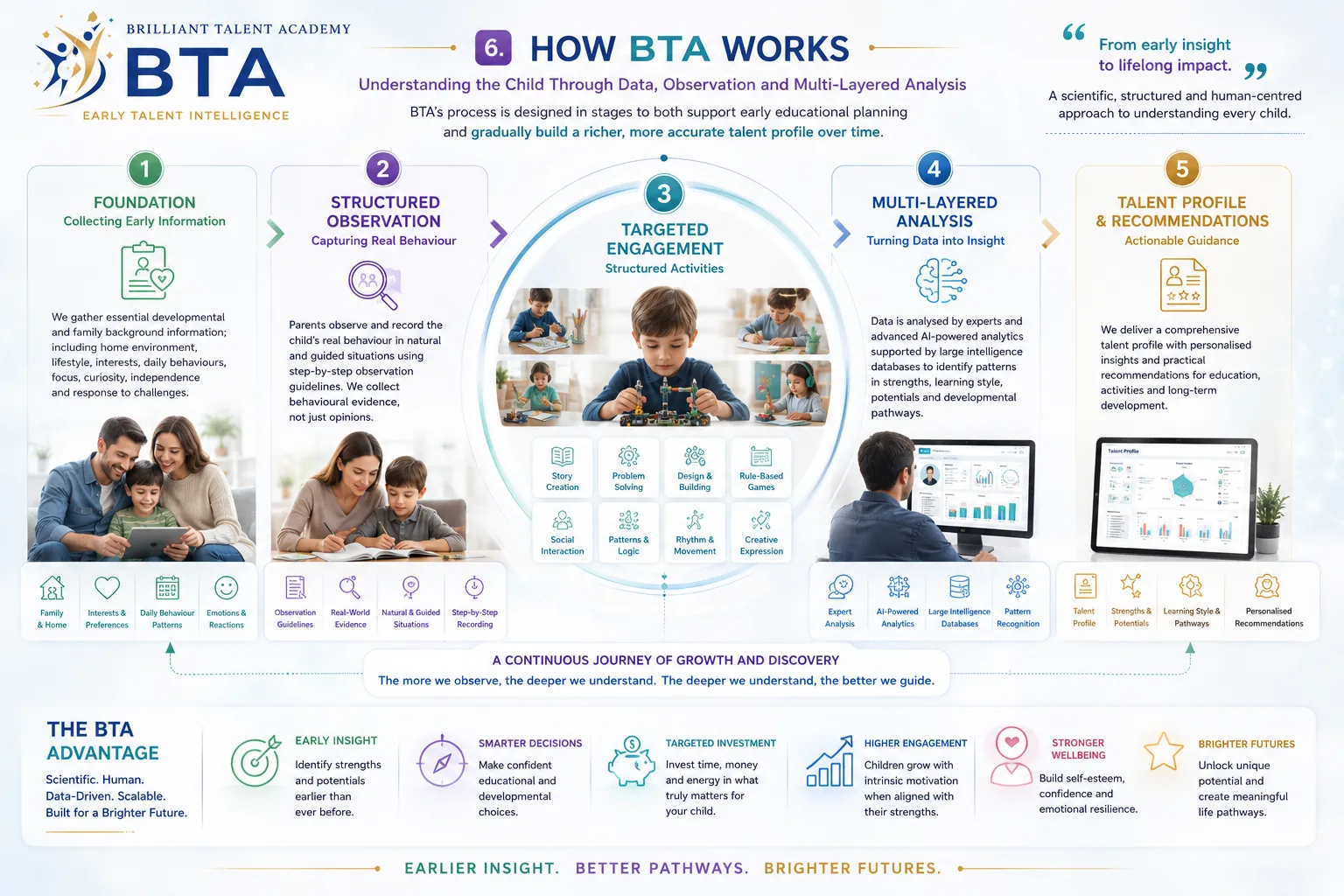
06 · How BTA Works
A staged journey from early information to multi-layered insight.
BTA combines developmental context, parent observation, guided child activities, uploaded evidence, specialist analysis and structured reporting.
Each stage adds more evidence. The result becomes more useful, more personalised and better aligned with the child’s real developmental pattern.
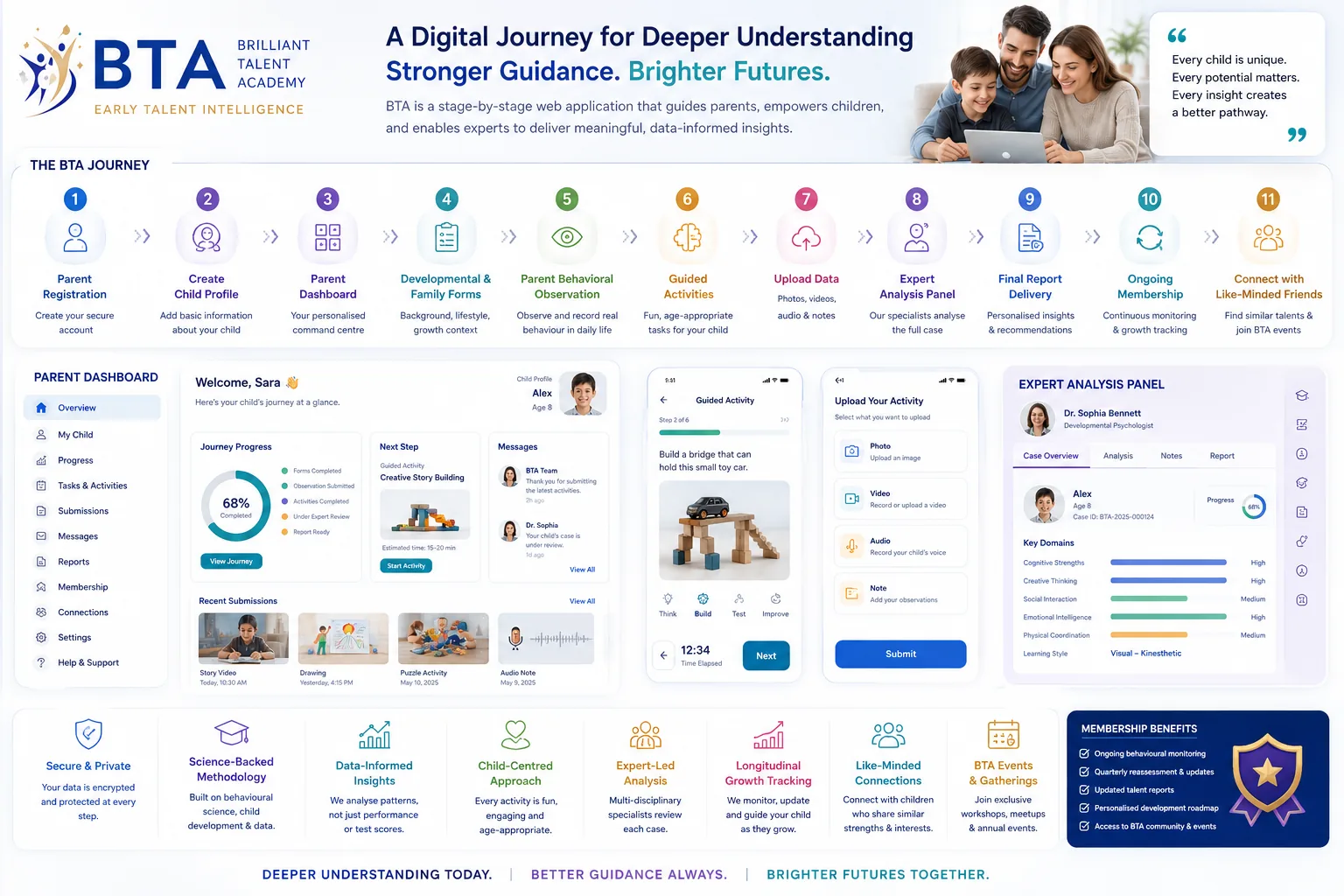
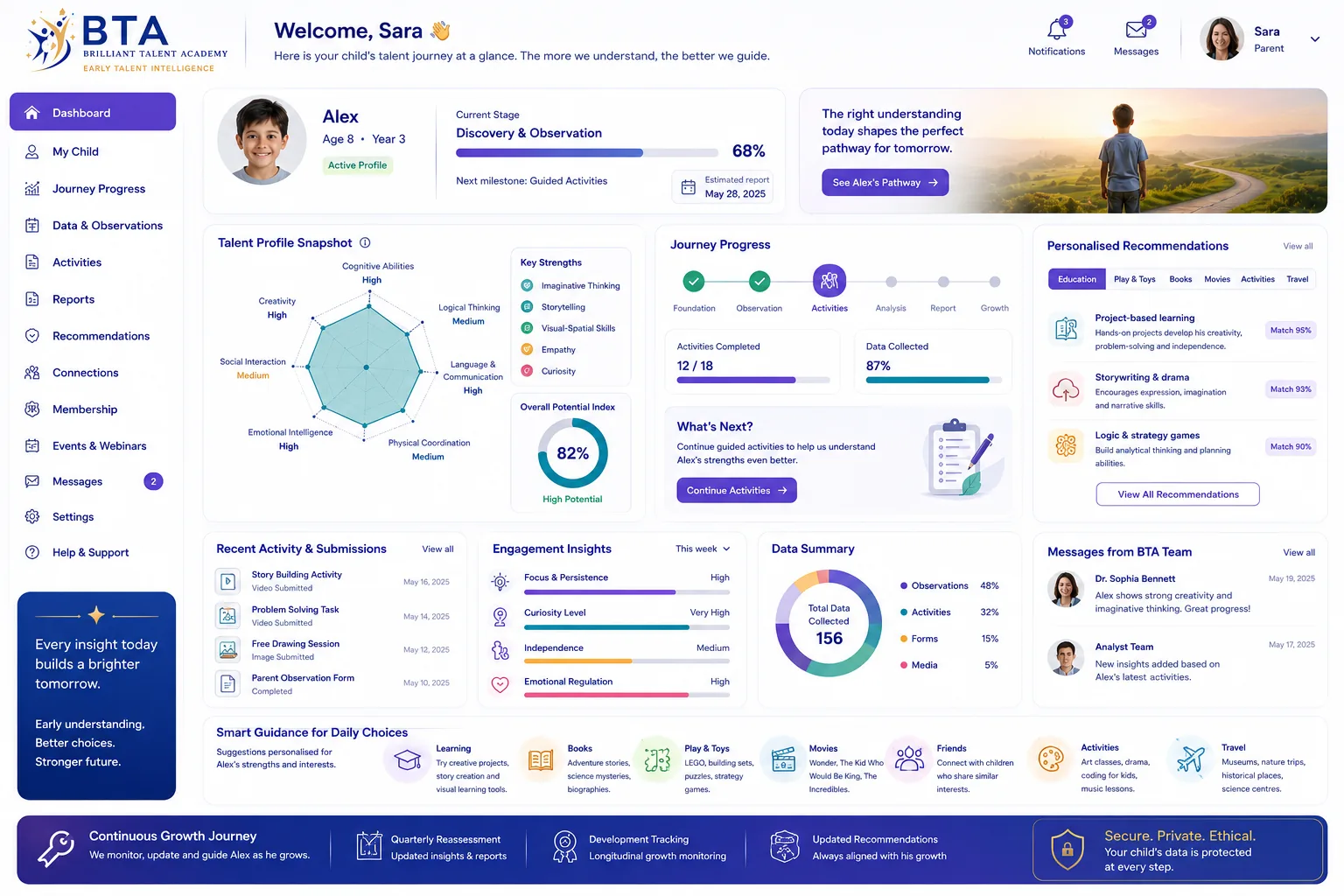
07 · Parent Dashboard Experience
A clear digital journey for parents, children and specialists.
The dashboard helps parents see where they are in the process, what has been completed, what is still needed and how the child’s profile is developing.
It turns a complex developmental journey into a calm, guided, premium and understandable experience.
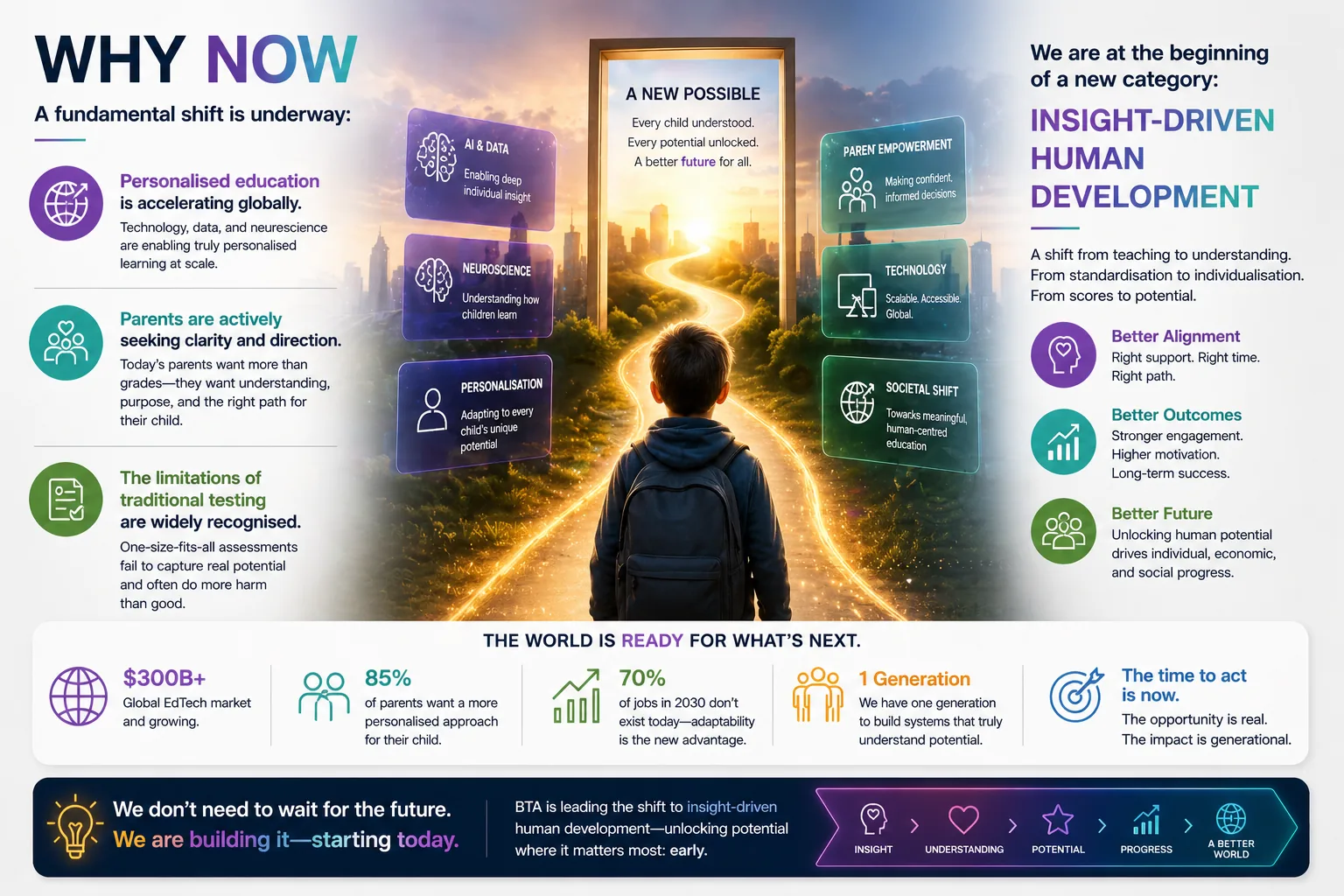
08 · Why Now?
Education is moving toward personalisation — but families and schools need deeper insight.
AI, data, changing work, personalised education and parent expectations are reshaping how children should be supported.
BTA has been designed for this moment: a shift from teaching alone to understanding, from standardisation to individualisation and from scores to potential.
09 · Unique Talent Profile & Capacity
Every child carries a unique capacity — but it must be seen at the right time.
Early understanding helps parents make more confident decisions about education, activities, books, play, friendships, leisure, travel and broader developmental experiences.
Better choices, targeted investment, less wasted energy, greater satisfaction and brighter futures begin with seeing the child more clearly.
10 · More than a Project — A Purpose
BTA is building toward a more conscious, aligned and humane future for development.
The purpose is not only to help children succeed, but to help them flourish in pathways aligned with their talents, interests, learning style, motivation and deeper sense of meaning.
From potential to purpose. From scattered effort to conscious guidance. From hidden capacity to brighter human futures.
For Parents
Understand your child earlier. Guide them better.
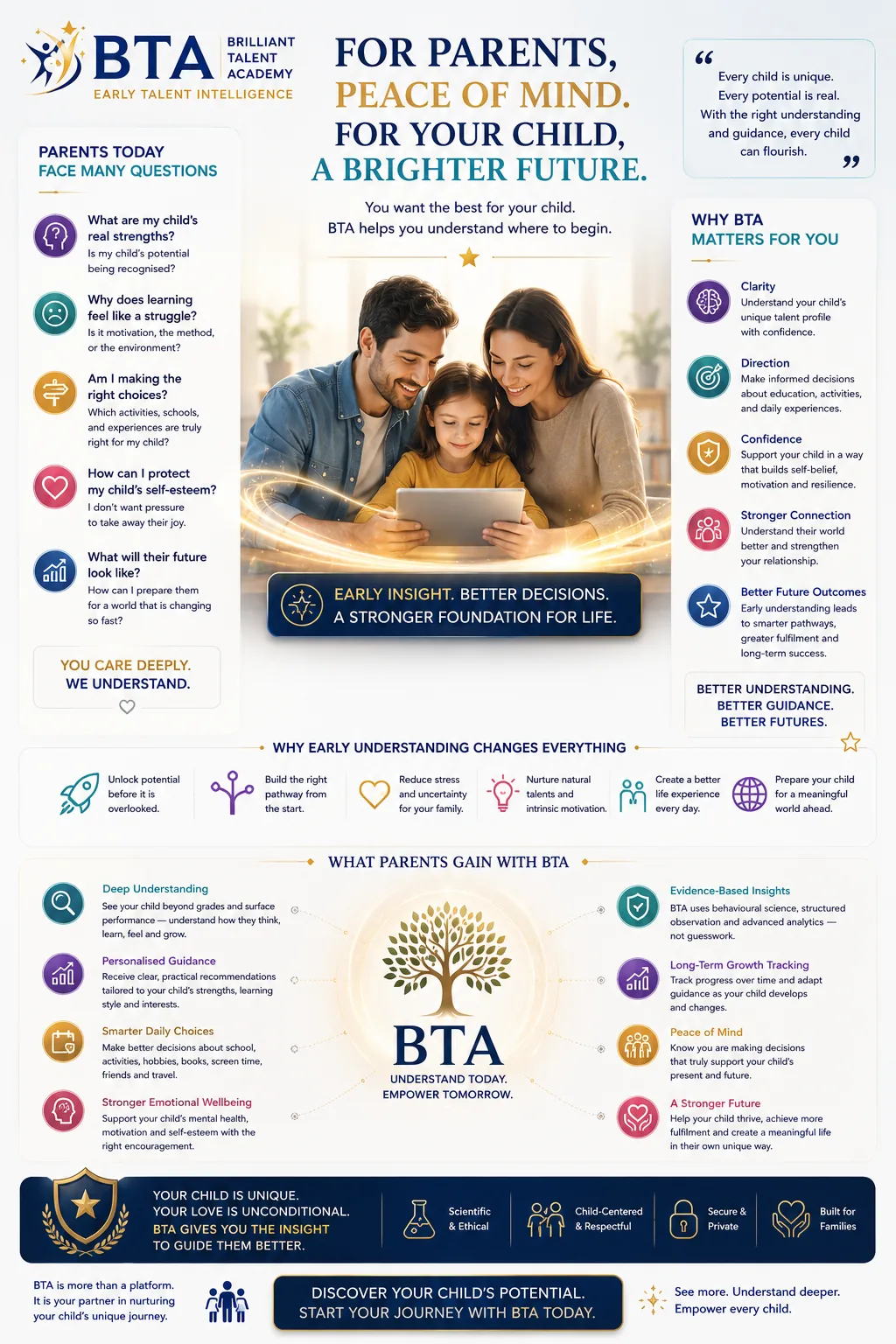
BTA gives parents a clearer view of their child’s natural strengths, interests, learning patterns and potential pathways — helping families make more confident decisions about education, activities, support and long-term development.
Read more
It helps parents move beyond guesswork, comparison and uncertainty by turning everyday observations into meaningful developmental insight.
1
Clarity for daily decisionsSchool choices, activities, books, play, friendships and wider development can become more aligned.
2
Confidence without pressureBTA supports the child without labelling them or forcing a narrow pathway.
3
Earlier insight, better guidanceThe earlier strengths are understood, the better the child can be supported.
For Schools
A small step for the school. A powerful shift for every child.
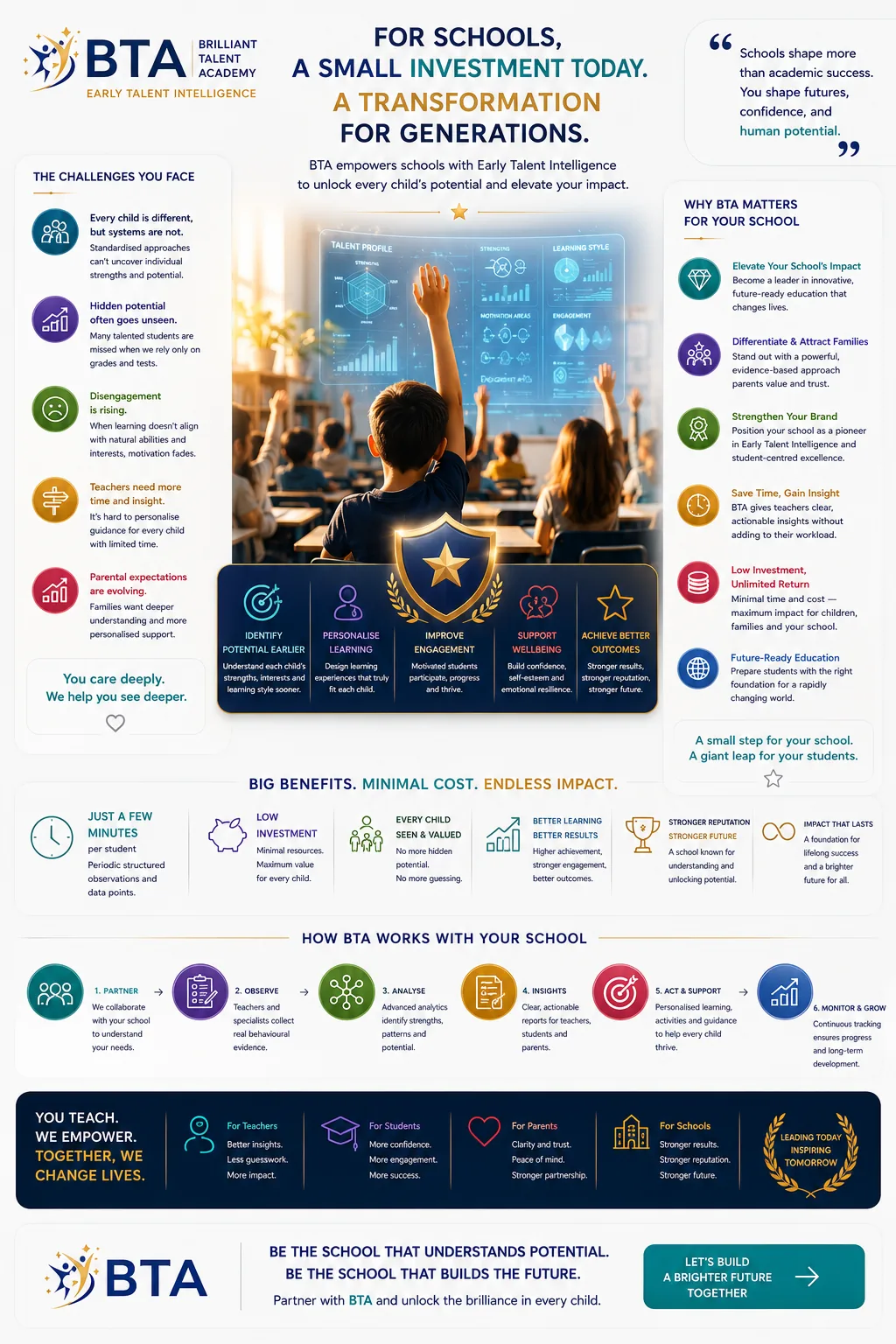
BTA supports schools with a structured, low-burden way to understand pupils’ strengths, learning styles and developmental needs more deeply — helping teachers, parents and school leaders make better-informed decisions with greater long-term impact.
Read more
For schools that want to stand out as child-centred, future-ready and evidence-informed, BTA adds a powerful layer of insight without creating heavy operational pressure.
✓
More insight, less guessworkUnderstand children beyond grades, tests and surface performance.
★
Stronger school reputationShow families that your school is serious about understanding every child.
↗
High-value impactA focused process can unlock better guidance, stronger engagement and brighter outcomes.
Clear answers. Deeper confidence. BTA is designed to help families and schools understand children beyond grades, labels and guesswork.
Click a question to open it. Opening another question closes the previous one.
BTA is an Early Talent Intelligence platform designed to help families and schools understand how a child thinks, learns, engages, responds and develops. It is built around structured observation, behavioural evidence, specialist review and data-informed insight.
The purpose is simple but powerful: to help children be seen earlier and guided better, before their strengths, motivation and potential are missed inside generalised educational pathways.
No. BTA is not a traditional test, exam, tutoring assessment or one-off scoring tool. It is designed to observe patterns in real behaviour through guided activities and structured parent input.
This matters because children are more than a single score. BTA focuses on understanding the child — strengths, interests, learning style, motivation, confidence, persistence and developmental direction.
Tutoring usually helps a child improve in a subject. BTA works at a deeper level: it helps identify how the child naturally learns, what motivates them, where their strengths may be emerging, and what kinds of pathways may fit them better.
BTA can support better decisions about tutoring, activities, school support and enrichment — but it is not tutoring itself. It is an intelligence layer for understanding the child more clearly.
Parents make hundreds of decisions about education, activities, books, screen time, friendships, hobbies, confidence, support and future direction. Without deeper understanding, many of those decisions rely on trial and error.
BTA helps parents move from uncertainty to clearer guidance. It gives families a more structured way to understand what may genuinely suit their child — and where time, energy and investment may have the greatest impact.
Parents receive a personalised Talent & Learning Profile that summarises the child’s observed strengths, learning patterns, behavioural tendencies, motivation signals and potential developmental directions.
The output is designed to be practical, not abstract. It helps parents think more clearly about education, enrichment, activities, support strategies and everyday choices that shape the child’s growth.
Yes. BTA is not only for children who are struggling. Many capable children still have strengths, interests or learning patterns that are not fully understood by grades alone.
For children already performing well, BTA can help guide enrichment more strategically — so their potential is not simply maintained, but developed with greater direction and confidence.
Often, yes. Low motivation does not always mean low ability. Sometimes it means the child’s learning pathway, environment or activities are not well aligned with how they naturally engage.
BTA helps look for signs of intrinsic motivation, curiosity, persistence and preferred ways of learning. When those signals are understood, parents and schools can make better choices about support and encouragement.
Yes. BTA is designed to support schools with a structured way to understand pupils beyond grades, test performance and general classroom impressions.
For schools, BTA can strengthen pupil insight, personalised support, parent communication and future-ready positioning — without replacing teachers or adding unnecessary complexity.
Schools are increasingly expected to understand pupils as individuals, not only as academic performers. BTA helps schools demonstrate a deeper, child-centred and evidence-informed commitment to every pupil.
A partnership with BTA can also strengthen the school’s reputation with parents: it shows the school is serious about future-ready education, personalised guidance and meaningful long-term outcomes.
No. BTA is designed to support professional judgement, not replace it. Teachers know children through daily interaction; BTA adds another structured layer of behavioural insight and developmental interpretation.
The best use of BTA is collaborative: helping teachers, parents and specialists see patterns more clearly and make better-informed decisions together.
BTA is being designed as a structured and low-burden pathway. The aim is to create meaningful insight without placing heavy additional pressure on teachers or school staff.
In school settings, BTA can be adapted around existing workflows, selected cohorts, pilot groups or partnership models. The focus is practical value, not administrative overload.
Yes. BTA is designed around responsible data handling, privacy, safeguarding awareness and careful treatment of child-related information.
The project is ICO registered and aims to build trust from the beginning. Data protection is not an afterthought; it is part of the platform’s ethical and operational foundation.
No. BTA does not aim to put children into fixed boxes or permanent labels. A child’s development is dynamic, and any meaningful understanding should remain open to growth and refinement.
BTA creates an evolving talent and learning profile. The goal is guidance, not limitation — helping families and schools see possibilities earlier and respond more wisely.
Yes. The long-term BTA model is built around longitudinal understanding. As more observations, activities and updates are collected, the child’s profile can become richer and more accurate.
This is one of BTA’s most important differences: it is not designed as a single moment of assessment, but as an evolving intelligence layer around the child’s development.
Early understanding matters because early choices shape confidence, motivation, identity and opportunity. When a child’s strengths are seen earlier, guidance can become more aligned and less reactive.
BTA helps families and schools act before potential is overlooked. The earlier the insight, the greater the chance of building a pathway that feels meaningful, energising and developmentally appropriate.
Families and schools can register interest through the founding pilot pathway. Pilot participation is designed for selected early users who want to help shape and validate the BTA experience.
Joining the pilot gives access to the first structured pathway toward deeper child understanding — while also helping BTA refine the model before wider rollout.


Contact BTA
Let's Start the Right Conversation.
For parent enquiries, school partnerships and founding pilot participation.
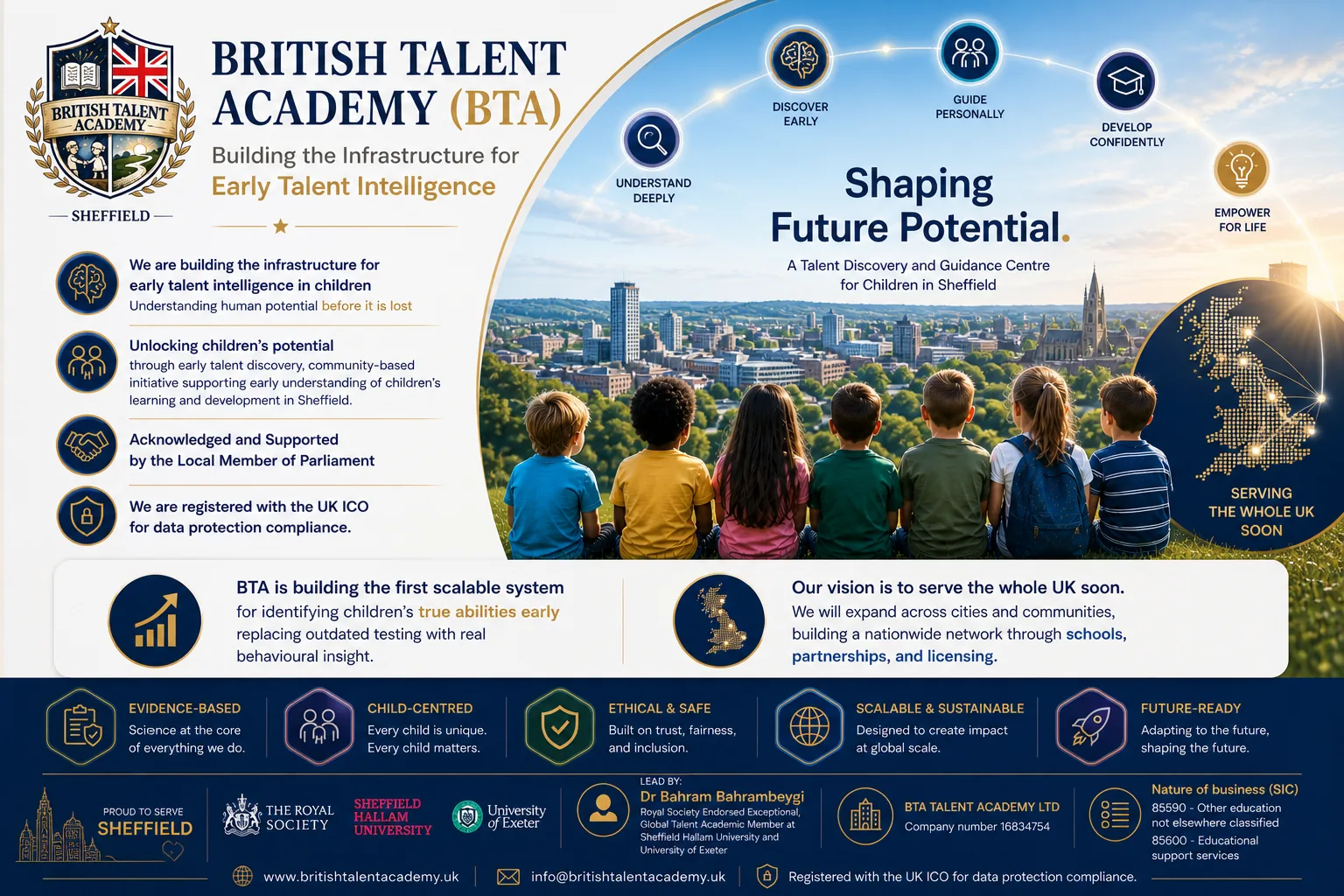
Sheffield · S10 5FA
British Talent Academy
Early Talent Intelligence for families and schools.
Contact BTA to discuss pilot places, school partnership opportunities, or how the platform can support clearer guidance for children's development.
Parent EnquiriesSchool PartnershipsFounding Pilot
Email BTA →Telephone
Based in Sheffield
S10 5FA
United Kingdom
United Kingdom
Website
Early understanding. Confident guidance. Brighter futures.