
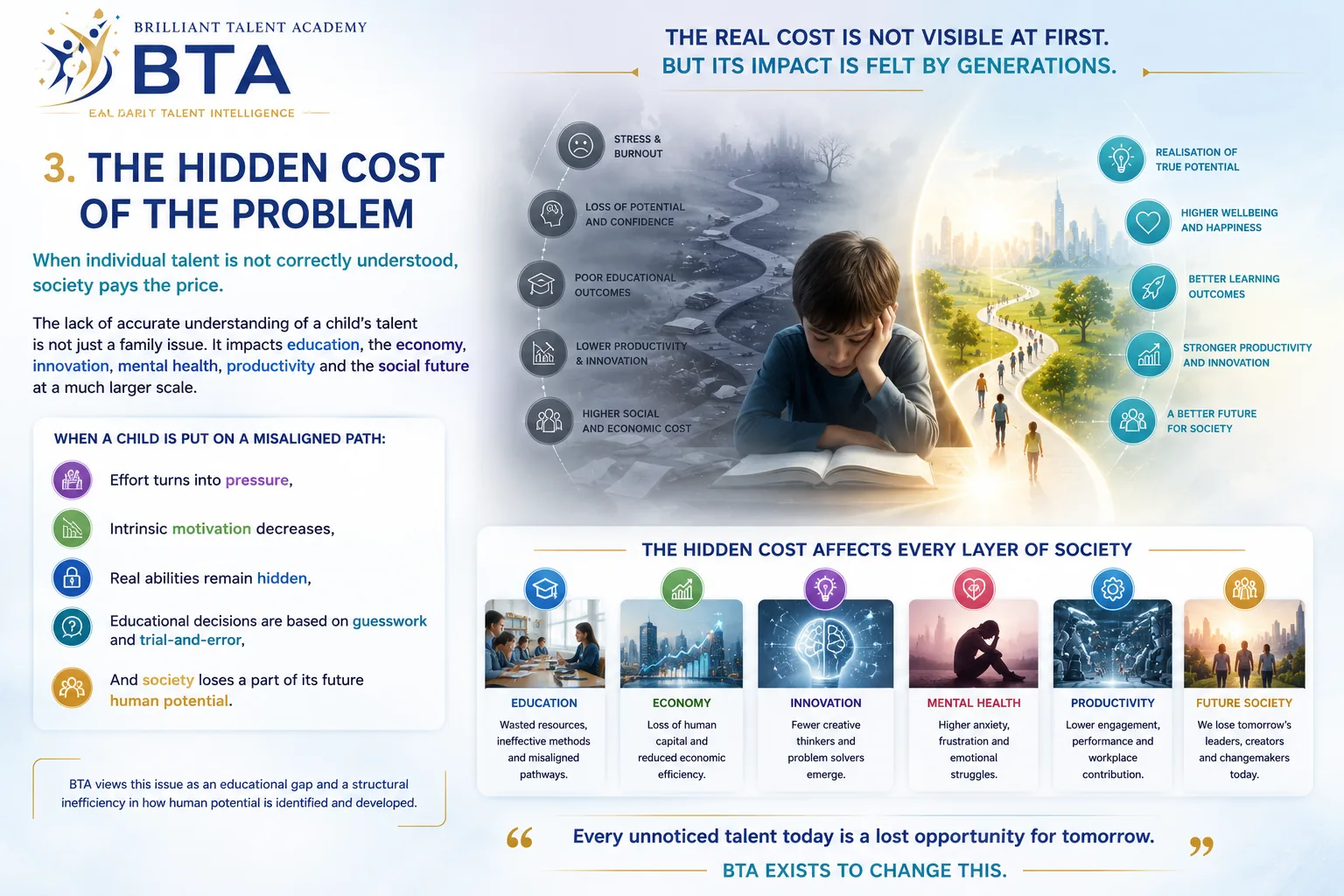
The cost of misaligned development reaches beyond the family into education, the economy, innovation, mental wellbeing, productivity, and future society.
The failure to understand a child’s talent accurately is not limited to the family. At a larger scale, this problem affects education, the economy, innovation, mental wellbeing, productivity, and the future of society.
When a child is placed on a misaligned pathway, effort turns into pressure, intrinsic motivation declines, real abilities remain hidden, and family decisions rely on guesswork, comparison, and trial and error.
BTA sees this not only as an educational gap, but as a structural inefficiency in the way human potential is identified, understood, and developed.
Costs for the child
When a child spends years on a pathway that does not fit, effort can turn into pressure. A child who is told they are “not trying hard enough” may in fact be working against the grain of how they learn best. Over time this can wear down intrinsic motivation and confidence.
Costs for the family
Parents often try one activity after another — a new club, a different tutor, another instrument — hoping something will click. Without a clearer picture of the child, these choices rely on guesswork, comparison with other children and trial and error, which can be tiring and expensive for everyone.
Costs for schools and society
Schools may miss strengths that do not show up in standard assessments, particularly in children whose abilities are uneven or expressed in less obvious ways. At a wider scale, BTA sees this as a structural inefficiency in how human potential is identified and developed.
Reducing the cost through earlier understanding
BTA’s response is to build a behaviour-based talent profile earlier, so decisions can be made with more insight. Knowing typical developmental milestones is also helpful, as it lets parents distinguish what is ordinary from what is distinctive.