
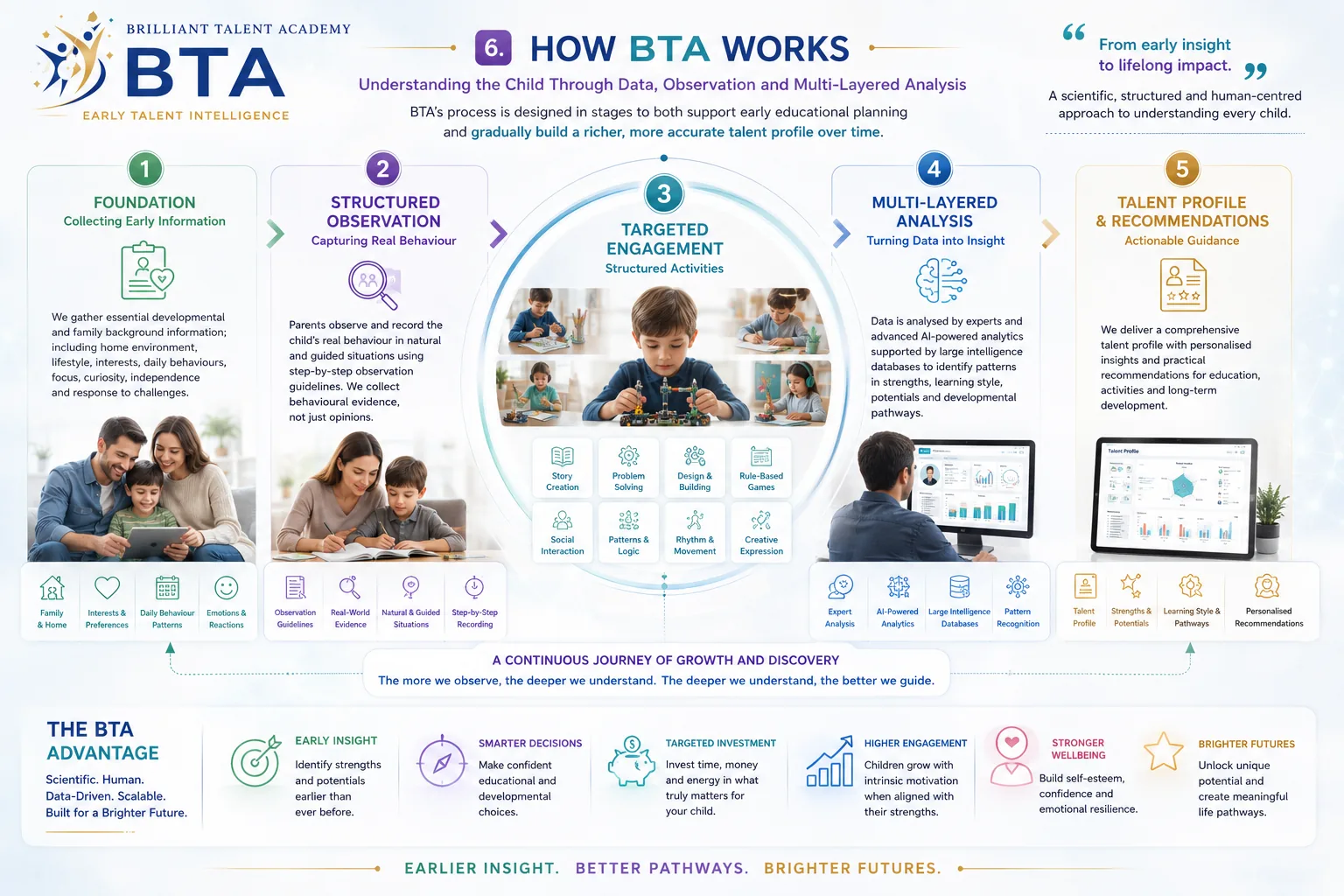
The BTA process is a staged pathway that gradually builds a more complete picture of the child’s talent profile.
The BTA process is designed as a staged pathway. It helps organise a child’s developmental and educational direction from the earliest meaningful stages, while gradually building a more complete picture of the child’s talent profile.
In the first stage, BTA collects foundational developmental and family-context information about the child — from the home environment and lifestyle to interests, daily behaviours, attention, curiosity, independence, and responses to challenge.
In the second stage, parents record the child’s real behaviour in natural and guided situations, following clear step-by-step instructions. Instead of relying on general opinions, BTA gathers behavioural evidence.
In the third stage, the child engages in purposeful activities such as storytelling, problem-solving, drawing and design, rule-based games, social interaction, pattern recognition, rhythm, and creative tasks.
These data are then analysed by specialists, supported by powerful data-analysis tools and intelligent large-scale data environments.
The BTA pathway, stage by stage
BTA does not try to describe a child from a single sitting. Each stage adds a different kind of evidence, so the final picture rests on several viewpoints rather than one score.
Stage 1: Foundation and family context
Parents share developmental and family-context information: home routines, interests, attention, curiosity, independence and how the child usually reacts to a challenge. This gives later observations a context, so a behaviour is read against the child’s real life rather than in isolation.
Stage 2: Structured observation at home
Parents record their child’s real behaviour in natural and guided situations, using clear step-by-step instructions. The aim is behavioural evidence — what the child actually did — rather than general impressions such as “she is good at maths”.
Stage 3: Targeted engagement activities
The child takes part in purposeful activities such as storytelling, problem-solving, drawing and design, rule-based games, social interaction, pattern recognition, rhythm and creative tasks. Different activities reveal different strengths, and how a child starts, persists and recovers from difficulty is as informative as the end result.
Stage 4: Multi-layered specialist analysis
Specialists review the information together, supported by data-analysis tools. Looking across family context, observation and activity evidence helps separate a consistent pattern from a one-off moment.
Stage 5: Talent profile and recommendations
Families receive a Talent Profile with practical guidance. Because children change, the profile is designed to keep developing as new information is added over time.
What this means for parents
For parents, the value is a calmer, better-informed way to make everyday decisions — which clubs to try, what kind of books or games to offer, and how to talk with your child’s school about their needs. BTA is a complement to school, not a replacement for teachers, the EYFS or the National Curriculum.
If you are wondering whether your child shows signs of unusual ability, or simply want to understand typical development before starting, these guides are a useful starting point:
What this means for schools
Schools can use the same staged approach to add a structured, behaviour-based view of pupils alongside existing assessment. Read more about working with BTA as a school, and how talent is usually identified in the UK system.
Frequently asked questions
Is BTA a test?
No. BTA is built around observation of real behaviour in structured situations, family context and specialist review, rather than a single test score.
Who records the observations?
Parents record their child’s behaviour in natural and guided situations, following clear step-by-step instructions provided through the BTA pathway.
Does the profile stay the same?
No. The BTA Talent Profile is designed to evolve as new developmental information is added while the child grows.